
Product Categories



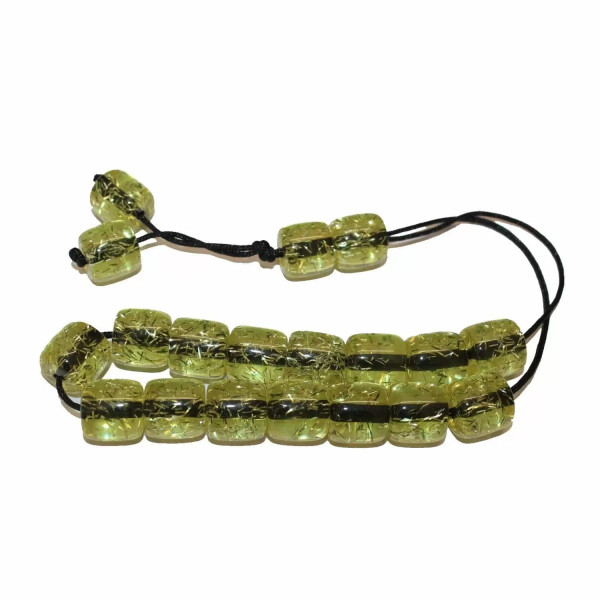
TRANSPARENT GREEN KOMPOLOY

Availability: Limited stock
CLASSIC HANDMADE KOMPOLOY IN A LARGE VARIETY OF COLORS.
History of the Rosary – A Journey Through Time and Tradition
The rosary is one of the most characteristic objects of Greek and wider Mediterranean culture. Although today it is mainly associated with Greece, it has a long and fascinating history, starting from antiquity and extending across various cultures.
The rosary is not just an object, but a story that has been passed down through generations and cultures. From its religious use in India and the Middle East to its transformation into a tool for relaxation and meditation in Greece, the rosary continues to maintain its unique place in our culture and tradition.
The rosary has its roots in the prayer beads of Orthodox Church monks, which were used for prayer and concentration. However, the practice of using beads on a thread is much older and can be traced back to many ancient cultures.
The earliest records of the use of beads in a similar form are found in India, China, and the Arab world, where rosaries (or similar objects) had religious or mystical significance. In the Middle East and the Islamic world, "misbahs" or "tasbihs" were used, types of prayer beads, used for counting prayers and chanting.
With the expansion of trade routes and the communication of cultures, prayer beads passed to the Ottoman Empire, where they became particularly popular among the upper classes and nobles. Gradually, from a prayer tool, it evolved into an object of relaxation and meditation, which brought about its transition to the Greek tradition.
The Komboloi in Greece
In Greece, the komboloi was mainly popularized during the Ottoman Empire, but became particularly popular in the late 19th and early 20th centuries. It no longer had a purely religious character, but was used mainly for relaxation, contemplation and personal enjoyment.
The Greek komboloi differs from the prayer beads of other cultures, as it does not follow a specific number of beads nor is it used according to strict rules.
During the 1920s-1950s, the komboloi became particularly popular among men, especially old guys, rebetes, sailors and coffeehouse dwellers. It was a symbol of calm, contemplation and masculine self-control. In traditional Greek coffeehouses and cafes, men would hold it in their hands and spin it slowly, either to kill time or to express their personality.
Holding a rosary was considered a sign of strength, prestige, and self-confidence. A person playing with his rosary showed that he was not in a hurry, was calm, and in control of the moment.
Men in cafes and harbors held it in their hands, playing with its beads, either to pass the time or to relieve the stress of everyday life. Often, the komboloi was associated with masculine tradition and free expression, while at the same time it was considered a symbol of prestige and social status.
Today, the rosary remains a favorite object for many people, regardless of age or social status. It is used as:
✔ Relaxation and concentration object
✔ Collectible piece
✔ Personal charm or symbol of power and prestige
✔ Decorative accessory and delivery item
The rosary continues to symbolize the Greek way of life and the need for moments of relaxation amidst the intensity of everyday life.
The rosary, although it has deep historical roots, acquired a special significance in modern Greece, which separated it from its religious use and established it as an everyday object of relaxation and personal enjoyment.
With the advent of the 20th century, the komboloi became one of the most characteristic objects of Greek popular culture.
The rosary became associated with political leaders and well-known figures. Many politicians, such as Andreas Papandreou, used the rosary in public, making it a symbol of relaxation and popular connection with the world.
The rosary is not just an object, but a story that has been passed down through generations and cultures. From its religious use in India and the Middle East to its transformation into a tool for relaxation and meditation in Greece, the rosary continues to maintain its unique place in our culture and tradition.
Tourists began to buy it as a souvenir from Greece, and thus the komboloi became identified with Greek cultural heritage.
It is a symbol of peace, patience and tradition – a gesture that keeps the Greek soul alive through time!
History of the Rosary – A Journey Through Time and Tradition
The rosary is one of the most characteristic objects of Greek and wider Mediterranean culture. Although today it is mainly associated with Greece, it has a long and fascinating history, starting from antiquity and extending across various cultures.
The rosary is not just an object, but a story that has been passed down through generations and cultures. From its religious use in India and the Middle East to its transformation into a tool for relaxation and meditation in Greece, the rosary continues to maintain its unique place in our culture and tradition.
The rosary has its roots in the prayer beads of Orthodox Church monks, which were used for prayer and concentration. However, the practice of using beads on a thread is much older and can be traced back to many ancient cultures.
The earliest records of the use of beads in a similar form are found in India, China, and the Arab world, where rosaries (or similar objects) had religious or mystical significance. In the Middle East and the Islamic world, "misbahs" or "tasbihs" were used, types of prayer beads, used for counting prayers and chanting.
With the expansion of trade routes and the communication of cultures, prayer beads passed to the Ottoman Empire, where they became particularly popular among the upper classes and nobles. Gradually, from a prayer tool, it evolved into an object of relaxation and meditation, which brought about its transition to the Greek tradition.
The Komboloi in Greece
In Greece, the komboloi was mainly popularized during the Ottoman Empire, but became particularly popular in the late 19th and early 20th centuries. It no longer had a purely religious character, but was used mainly for relaxation, contemplation and personal enjoyment.
The Greek komboloi differs from the prayer beads of other cultures, as it does not follow a specific number of beads nor is it used according to strict rules.
During the 1920s-1950s, the komboloi became particularly popular among men, especially old guys, rebetes, sailors and coffeehouse dwellers. It was a symbol of calm, contemplation and masculine self-control. In traditional Greek coffeehouses and cafes, men would hold it in their hands and spin it slowly, either to kill time or to express their personality.
Holding a rosary was considered a sign of strength, prestige, and self-confidence. A person playing with his rosary showed that he was not in a hurry, was calm, and in control of the moment.
Men in cafes and harbors held it in their hands, playing with its beads, either to pass the time or to relieve the stress of everyday life. Often, the komboloi was associated with masculine tradition and free expression, while at the same time it was considered a symbol of prestige and social status.
Today, the rosary remains a favorite object for many people, regardless of age or social status. It is used as:
✔ Relaxation and concentration object
✔ Collectible piece
✔ Personal charm or symbol of power and prestige
✔ Decorative accessory and delivery item
The rosary continues to symbolize the Greek way of life and the need for moments of relaxation amidst the intensity of everyday life.
The rosary, although it has deep historical roots, acquired a special significance in modern Greece, which separated it from its religious use and established it as an everyday object of relaxation and personal enjoyment.
With the advent of the 20th century, the komboloi became one of the most characteristic objects of Greek popular culture.
The rosary became associated with political leaders and well-known figures. Many politicians, such as Andreas Papandreou, used the rosary in public, making it a symbol of relaxation and popular connection with the world.
The rosary is not just an object, but a story that has been passed down through generations and cultures. From its religious use in India and the Middle East to its transformation into a tool for relaxation and meditation in Greece, the rosary continues to maintain its unique place in our culture and tradition.
Tourists began to buy it as a souvenir from Greece, and thus the komboloi became identified with Greek cultural heritage.
It is a symbol of peace, patience and tradition – a gesture that keeps the Greek soul alive through time!
Sorry, no reviews found for product TRANSPARENT GREEN KOMPOLOY. Be the first to write one.
Write your review!
Write your review!